For UK candle, wax melt, and home fragrance sellers
CLP Labels With a Classification Record You Can Show
Sign up free — 14-day Maker trial, no card required.
Work through the CLP addition method without deciphering the regulation line by line. CraftCert turns your declared ingredients into a draft label, pictograms, and an exportable classification record — ready for you or your assessor to review.
CLP Labelling Is More Complex Than It Should Be
For small craft sellers, CLP compliance often means piecing together SDS documents, forum advice, and spreadsheets — with no structured record to show a marketplace or inspector.
Regulations are hard to decode
CLP rules span multiple binding annexes and update regularly. One wrong hazard statement can make a label non-compliant — and you liable.
Per-product consultancy adds up
Independent assessors typically charge per classification. When you have 20 candle variations and reformulate regularly, the drafting work adds up fast.
Spreadsheets don't scale
Tracking SDS documents, allergen lists, and H-codes across dozens of products in a spreadsheet is an accident waiting to happen.
Trading standards are checking
Marketplace takedowns and trading standards visits are increasing. Without documentation, there's no evidence you're compliant.
Free for up to 3 products, with draft label PDFs for one product a month. Maker plan from £9/month — unlimited labels, less than the price of one candle. Start free
Built for UK candle, wax melt, and home fragrance makers
Four outcomes, one platform — purpose-built for UK craft sellers.
Draft CLP labels from your formulation
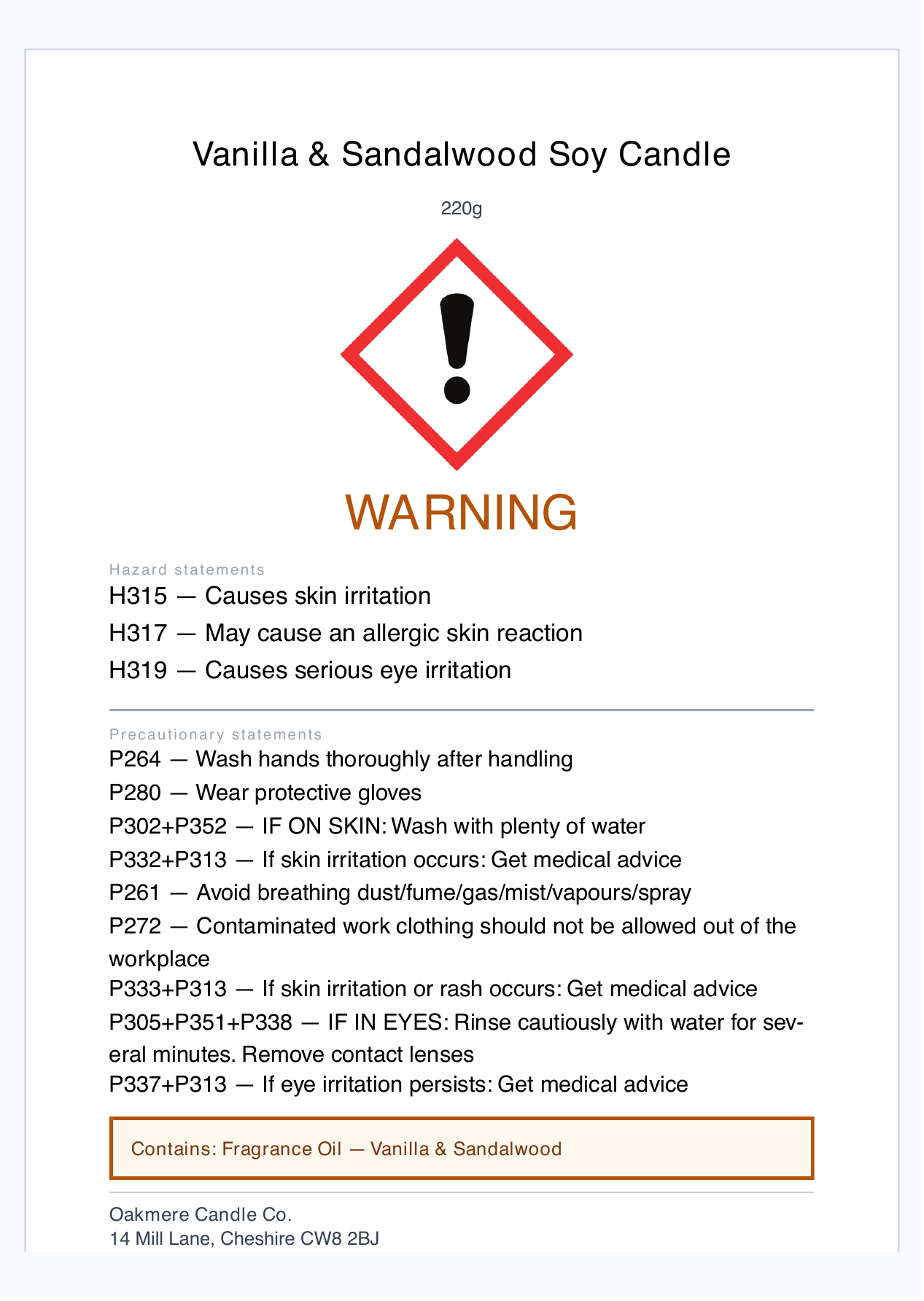
Classify your declared ingredients and produce draft labels for candles, wax melts, diffusers, and room sprays — with applicable pictograms, signal words, and statements.
Track formulations and allergens
Store every ingredient, concentration, and allergen flag in one place. Update a formulation and re-classify to update your label.
Build exportable classification records
Keep a documented trail of classifications, ingredient references, and label versions — ready to share with an assessor, marketplace, or trading standards.
Re-classify when formulations change
Update your ingredient data and regenerate the draft label. Every version is tracked in your record.
From Ingredients to Draft Labels in Three Steps
Enter your formulation, classify and draft a CLP label, and keep exportable records for your assessor or trading standards.
Enter your ingredients
Add your product formulation with ingredient names, CAS numbers, and concentrations from your supplier Safety Data Sheets.
Classify and draft your label
CraftCert applies the CLP addition method to your declared ingredients and identifies applicable GHS pictograms and statements, then produces a print-ready draft label.
Download and maintain records
Download your label, store your classification rationale, and keep exportable classification records and evidence for every product.
Check Your Compliance for Free — No Account Required
Free guided tools to check your CLP labels, find the right hazard pictograms, and review cosmetic labelling — no sign-up required.
Sell With Confidence on Any Marketplace
Compliance is the cost of selling regulated products. CraftCert makes that cost manageable.
Unlike supplier-tied tools, CraftCert classifies your finished product, not a single oil at neat strength.
New candle variation? Draft a label in minutes
Produce a draft CLP label in minutes rather than hours of SDS cross-referencing. Review it yourself or hand it to your assessor for sign-off.
Documentation ready when a marketplace or inspector asks
Generate a PDF evidence pack — classification rationale, formulation snapshot, label data, and allergens — to share when Etsy, Amazon, NOTHS, or trading standards ask for your working.
Reformulate? Update all your labels from one dashboard
When you reformulate a product, update your ingredient data in one place and regenerate the draft label.
New to CLP? Start with the background
Need the regulatory background first? Read our complete guide to UK CLP labels for the full regulatory picture, or go straight to the step-by-step CLP labelling for candles and wax melts.
Not sure if your product falls under CLP or cosmetics? Use our CLP vs cosmetics decision guide to work out which framework applies to your products.
Frequently Asked Questions
Answers to common questions about CLP compliance and CraftCert.
CLP Compliance
What are CLP labels and do craft sellers need them?
Do I need a CLP label for candles and wax melts?
What information must appear on a CLP-compliant label?
Are cosmetics and soaps covered by CLP?
What happens if I sell products without proper CLP labels?
Are there CLP labelling requirements for reed diffusers and room sprays?
About CraftCert
Does CraftCert replace a qualified safety assessor?
How much does CraftCert cost?
Is my formulation data secure?
Who is behind CraftCert?
Can I cancel at any time?
Cosmetics makers — what we help with
We help cosmetics makers with the labelling side. Allergen detection and CLP-vs-cosmetics decision support are in our free tools (see the Cosmetic Labelling Checker). The full Cosmetic Product Safety Report (CPSR) and SCPN notification still need a qualified safety assessor — we don't replace that.
If a deeper cosmetics workflow (CPSR builder, INCI labelling, PIF) would help you, add yourself to the cosmetics waitlist →
If you make toys or children's items (EN 71 / Toy (Safety) Regulations 2011), that's named in our product brief but not yet shipped — add yourself to the EN71 waitlist →
Other frameworks we don't cover: food labelling (FIC / Natasha's Law), CE / UKCA marking for non-CLP goods, electrical products, food-contact materials. Look for tooling specific to those frameworks.
Your Labels Should Be as Good as Your Products
Classify formulations, draft CLP labels, and keep exportable records — free for 3 products, with label PDFs for one product a month.